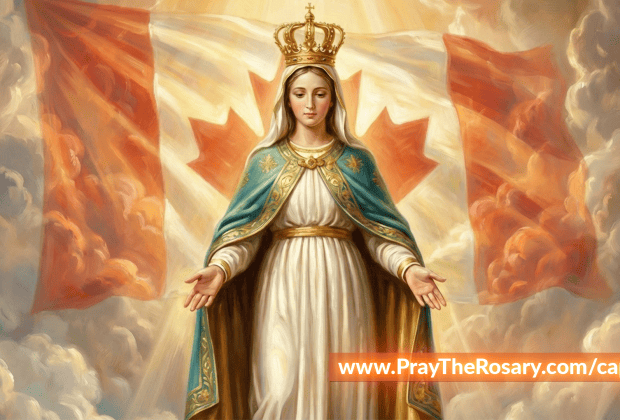
My friend, have you heard of this miraculous story of Our Lady of the Cape and the "Rosary Bridge"? Well do you ever have a treat should you choose to listen to this inspirational story!
SPCECIAL REQUEST: While you are here, will you please say a special pray for the healing of Yvette? Please pray for her leg and her sweet heart, that God will heal her in mind, body and soul and give her the strength to carry her cross with Our Beloved and Most Merciful Jesus. Yevette is the one who shared this with me.
Our Lady of the Cape & the 'Rosary Bridge'
In Cap-de-la-Madeleine, Quebec, the parish needed stone from the far side of the St. Lawrence River to build a bigger church—but the winter of 1878–1879 stayed strangely mild, and the river wouldn’t freeze, so the whole project looked sunk (or at least splishy-splashy). Their priest, Fr. Luc Desilets, asked everyone to pray the Rosary and even promised Mary that if she helped, the old church would be dedicated to her. Then, in March 1879, chunks of ice drifted down and knit together into a “bridge” across the river; the people poured water over it for days to thicken it into a workable path and joyfully hauled the stones across—later calling it the “Rosary Bridge.”
Let's together build a "Rosary Bridge" in our Rosary family by praying the Rosary together and for each other each day! What amazing things God can do in us if we only say "yes" and pick up our Rosary and pray it.

The Rosary Bridge of Canada: When Prayer Turned a River into a Road
Picture a small riverside parish in Quebec, staring at a wide, stubborn stretch of the St. Lawrence River and thinking: “Well… we need those building stones from the other side.” The plan was simple: wait for winter, let the river freeze solid, and haul the stones across on sleds. Nature, however, did not read the memo. (source)
The problem: a church too small… and a winter too warm
In the late 1870s, Cap-de-la-Madeleine (now part of Trois-Rivières, Quebec) had a renewed wave of faith and a growing congregation—so they needed a bigger church. The building materials were ready to be brought over the frozen river… except the winter of 1878–1879 was unusually mild, and the St. Lawrence didn’t freeze over the way it normally would. (source)
That’s when Fr. Luc Desilets urged the people to do what Catholics do best when the situation is impossible: pray. Specifically, he encouraged the Rosary, asking for Mary’s intercession for a passable “ice road.” He even made a promise: if they could get the materials across, he would dedicate the old fieldstone church to Our Lady instead of tearing it down. (source)
The miracle: an ice bridge appears
Then, in March 1879, something extraordinary happened. Ice began to gather and form a kind of bridge across the river—enough to create a crossing. The shrine’s own historical summary describes it as an “ice-bridge,” commonly called the Rosary Bridge, because it was linked to the Rosary prayers of the people. (source)
A particularly striking detail from shrine-related summaries is that the ice began forming around mid-March, and parishioners transported the stones during a short window later that month—often described as happening from March 19 to March 25, 1879. (source)
And it wasn’t just “hop on and go.” People reportedly poured water onto the ice to thicken and strengthen it—basically turning prayer + hard work into a real path for hauling heavy stones. (source)
A “bridge” with a name—and a promise kept
Because the crossing was so tied to the Rosary, the event picked up its legendary nickname: the Rosary Bridge (also called the “ice bridge” or “bridge of rosaries” in some retellings). (source)
And Fr. Desilets followed through on his vow: the old church became dedicated to Our Lady under the title Our Lady, Queen of the Most Holy Rosary—an important moment in the story of what would grow into a major Marian shrine. (source)
The story doesn’t stop there: the wider “Our Lady of the Cape” timeline
The Rosary Bridge is often told as the “first big sign” that helped ignite wider devotion at the Cape. Shrine materials commonly connect the 1879 ice bridge with the growth of the pilgrimage site and Canada’s Marian devotion. (source)
Later, in 1888, another famous event associated with the shrine is often called the “Miracle of the Eyes,” where witnesses reported the statue seemed to open its eyes during prayer. (source)
And in 1904, Pope Pius X granted a canonical coronation for the statue, further strengthening the devotion’s prominence. (source)
The “Rosary Bridge” you can walk across today
Now here’s the twist: the original “bridge” was ice—temporary and dramatic. But there is a physical bridge on the shrine grounds today that commemorates it: Le Pont des chapelets / the Rosary Bridge, built in 1924 as a memorial to the 1879 event. (source)
Why this story still hits people right in the heart
Whether you come at it as history, faith, or “wait—an ice bridge, in March, exactly when they needed it?”, the Rosary Bridge story has a stubborn, beautiful message: prayer isn’t passive—it can gather a community. Hope doesn’t require perfect conditions. And sometimes the “road” appears after you start walking in trust.
Or, to say it in a slightly goofy-but-reverent way: the parish needed a bridge… and heaven basically said, “Okay. But bring your buckets—let’s thicken that ice.”